Last month, essays like Randy Turner’s “A Warning to Young People,” and Christine McCartney’s Letter of Resolution, gave voice to teachers who have decided to quit the profession, and those who’ve committed to stay in teaching despite their shared frustrations — including standardized testing, merit pay, and Common Core Standards.

After four years as a high school biology teacher, Rose left her job, and the education field, in 2011. In today’s post, she reflects on the joys (yes, the joys) of leaving teaching. Check back for her take on the downsides of leaving.

Starting a new job is like starting a new relationship.  In the beginning, you’re just getting to know each other, and as time goes on, you decide if you’ll go long term. Sometimes, you realize you love your partner, but the relationship just isn’t healthy.

This is what happened to me with teaching: though our relationship had wonderful moments, I became increasingly unhappy, and decided to end it.

It’s been two school years since I’ve had the pleasure (and sometimes pain) of teaching teenagers. I now work in a cubicle pushing papers and have a much more stable relationship with my job.

Why I’m glad I left teaching:

1.  The simple pleasures of a desk job.

In the morning, the office and my cubicle are quiet and calm. I can ease into my day by enjoying a cup of tea while I go through emails. I use the bathroom whenever I want. I slowly eat my lunch. Full adult conversations are the norm!  This goes for thoughts as well. I can think through a problem and be confident about the decision without being interrupted fifteen times by students, colleagues, or P.A. announcements.

Several health problems went away, like indigestion (from scarfing my lunch before giving a make up test during my lunch break), foot pain (Goodbye Dr. Scholls!), and headaches (Yes, I had chronic tension headaches). I’ve also had fewer colds and flus (I come in contact with 30 office workers in a day instead of over 100 students and faculty). I call these the simple pleasures because, while they are not earth-shattering reasons, they still make my day easier.

Imagine going to the bathroom when you need to...

2. I got myself back.

Teaching takes a lot of physical and mental energy. I was drained when I got home. I didn’t have time for hobbies, friends, or anything else except grading at night.  Now, at 5 o’clock, my workday ends when I leave my cubicle…truly. I don’t think about it until the next morning when I get to work! After work I read a book, enjoy cooking dinner, and I spend time with my family! You may not believe this, but I have time and energy to exercise and take an art class!

Pottery class after work, anyone?

3. A weight was lifted from my shoulders.

I can be myself in public, in private, and at work.

As a teacher, I felt like I had to project this “perfect teacher” persona. I had to be the epitome of calm, conservative moral behavior. I felt like I could not go out to a restaurant, have an alcoholic beverage and sneak a kiss from my partner without worrying if a student or parent saw me.  Society puts this tremendous pressure on teachers as if their every decision, act, and word can inspire or devastate students.  If a student failed, it was the teacher’s fault. If the student succeeded, then it was the achievement of the student alone. Teachers shoulder all the responsibility, but get little recognition for their students’ achievement. I’m glad I don’t have to deal with this pressure anymore.

No more Ms. Perfect

No more Ms. Perfect…

4. My frustration with the American education system dissipated.

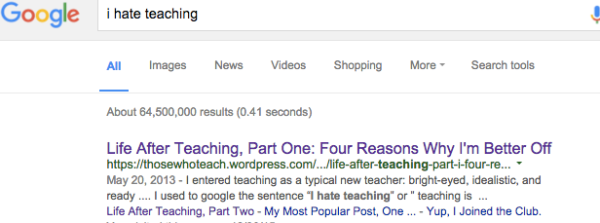
I entered teaching as a typical new teacher: bright eyed, idealistic, and ready to inspire tomorrow’s leaders. And then the reality of teaching slowly, but surely, squeezed the passion out of me. When I tried to make changes in my own small way to try shield my own students from the problems that plague the system, it seemed useless. It became hard to face the students, parents, administrators, colleagues, and myself knowing all the problems with the education system and feeling not only powerless to solve them, but forced to contribute to them (I’m looking at you, standardized testing).

I felt like a teenager who just got a summer job at her favorite fast food restaurant.  Instead of eating what I loved every day, I never ate it again after I saw how it was prepared.   So when I left teaching, I stopped struggling with the gap between what I wanted teaching to be, and what it actually was. My anger towards the system has dissipated, but a small bit of frustration will always be there because I still care about students.

The calm after leaving teaching

Former teachers, what have you gained from resigning or retiring from the classroom? How did leaving help you reflect?

What would make teaching a sustainable job for more people?

Science fiction writer Octavia Butler passed away seven years ago last month. Her most famous book,Kindred, tells the story of Dana, a black woman who time travels from 1976 to the pre-Civil War South. She meets a young white boy named Rufus, who also happens to be Dana’s ancestor.

octavia_butler

I just started Kindred with my ninth graders. Octavia Butler is the only writer of color, and one of two women writers, in our curriculum this year.

So, it was important to me that she have a legitimate space in my class, and that we face the subject of Kindred — the legacy of slavery — explicitly.

As a start, we read her obituary in The New York Times, which quotes from various interviews with Butler.

To the LA Times in 1998, she said:

I’m black, I’m solitary, I’ve always been an outsider.

One student admired Butler’s openness and ownership of her differences. Another student said Butler calling herself  ”an outsider” even in 1998 made him “depressed” that she would still be made to feel this way so recently.

In an interview with The New York Times in 2000, Butler noted:

“The only black people you found [in science fiction] were occasional characters or characters who were so feeble-witted they couldn’t manage anything, anyway. I wrote myself in because I’m me, and I’m here, and I’m writing.”

Several students saw this as Butler working deliberately to fix a problem she saw, and said that they too, had noticed the lack of diversity in their reading — and TV shows, and movies.

I think her saying, “I’m me, and I’m here, and I’m writing,” shows such a strong affirmation of her own existence – a refusal to be an invisible minority.

Finally, we talked about the observation that ends the article:

“We are a naturally hierarchical species. When I say these things in my novels, sure I make up the aliens…but I don’t make up the essential human character.”

We discussed what it means to be “hierarchical,” and whether humans are naturally competitive, or predisposed to oppress anyone who doesn’t conform to the majority group. Some students who weren’t sci-fi fans also said Butler made them want to discover how she used the genre to make statements about the real world.

I can’t say that I’m a sci-fi fan either, but I’m loving the discussions we’re having. Reading Butler’s reflections  turned out to be a great way to start the unit — she got us talking and thinking critically about race, class, and gender before reading a word of her book!


I’ve received several requests to explain the Chalk Talk activity from my post on teaching Catcher in the Rye.

This year, I’ve also used it to discuss The Odyssey, Oedipus Rex, and Great Expectations — but it can work for any subject, as long as you’ve got a board and chalk or markers.

I first learned to Chalk Talk in a course called Theater in the English Classroom I took last summer. Thanks to my teacher Angela Brazil for this strategy!

Here’s what to do:

1. Write your topic on the board.

In my theater class, the word was “Revenge.”

For Catcher, I wrote, “Holden: typical teen or mentally disturbed?”

2. Invite students to respond to the topic — with definitions, quotations, questions, even pictures.

What happens next is fun and refreshing to watch: a group of students will rush to the board, eager to share their ideas and respond to each other.

CT1

holdenchalktalk

I look for students who hang back and invite them to add their thoughts, too. Everyone participates in some way, even the quiet kids. I also appreciate how this activity helps push our thinking further than usual if we begin class with it.

3. Once everyone is back in their seats, we reflect on what they’ve made.

chalktalkfull

Then, I ask questions such as:

What do you see that you like?

What do you notice?

What did you add?

I also comment on these questions, and relate them to new questions for us to discuss.

4. You can go anywhere from here, including introducing a text, going back into a text, and asking students to write more on the topic.

Now, each time I announce a Chalk Talk, my students say or whisper, “Yessss!”

It’s no surprise, of course: kids are itching to express themselves, and writing on the board is an irresistible impulse. Case in point — these love notes (including marriage proposal!) from my students last year:

Dear Miss Ling

Now, as cute as the notes are, I know their writing is more about loving writing on the board than me!

It’s been more than two months since my last post! To help make up for that gap, here’s a story so good, I think it’s movie material…

Almost 40 years later, Jeff Kelly Lowenstein still remembers the feeling of community in “4T,” Paul Tamburello’s fourth grade class at Pierce School in Brookline, Massachusetts. “He knew all of us, and had high expectations for us,” Jeff says. “He was really good about letting us know that he saw what we were doing, whether it was doing well or misbehaving.”

Jeff (right) learns to use chopsticks in 4T.
photo credit: Paul Tamburello

Though he graduated from 4T in 1974, Jeff kept coming back to visit his old teacher, even throughout high school and college.  During these visits, Jeff recalls, “He would always say, ‘What do you remember from 4T?’ Then he would use that information to think about how to approach the class.” This commitment to continual improvement inspired Jeff, who began working at Pierce – first as a recess aide, and then, after graduation from Stanford, as an apprentice teacher to Tamburello for two years, beginning in 1987.

Jeff as Mr. Tamburello's apprentice teacher Photo courtesy of Jeff Kelly Lowenstein

Jeff as Mr. Tamburello’s apprentice teacher
Photo courtesy of Jeff Kelly Lowenstein

On the experience of having Jeff back in his classroom as an aspiring teacher, Paul Tamburello writes:

I was used to training student teachers but none with whom I had this kind of history. I hesitated. Was my work good enough, rigorous enough, to keep him engaged? I knew Jeff held me in high regard, maybe even considered me a role model. It’s a long fall from a pedestal to the solid, hard earth. Finally, I took the advice I gave my students. Don’t be afraid to try, maybe even fail.

(…)

There were days I shook my head and grinned in wonder. Jeff’s initiative was taking our relationship into rich uncharted territory. This was giving the term “student teacher” a whole new dimension. It would give us things to talk about for years to come.

By our second year of co-teaching, it was, “Jeff and I expect you to…” or “Mr. Tamburello and I expect you to…” as we ran the classroom. Jeff may be the only kid in America who got a post-graduate degree in fourth grade. It was the richest experience of my 34-year career.

In 1992, Jeff finally had his own classroom: he began teaching Social Studies and English at Brown Elementary School in Newton, Massachusetts — only five miles away from Pierce School. Mr. Tamburello continued to guide his student of now 18 years:

“I would emulate a lot of the things I learned from his classroom, including his sense of discipline, and the positive environment he established.” Jeff adds, “Now, when I would go back to visit, he would still be trying new things, and this would give me more homework to do as a teacher.”

Jeff’s memoir about these experiences, On My Teacher’s Shoulders, was published in 2012.  On his decision to write a book about Mr. Tamburello, Jeff says, “A big motivation was to honor the different, but related types of impact he played on me over the course of 30 years. It was not a static relationship: each time [I came back] there was something different that I had to learn and he had to teach me. I feel very fortunate that he had the strength and humility to let me know what he was gaining each of those different times. That helped me understand the reciprocity of shared important experiences.”

Paul (left) and Jeff (right) at Paul's retirement partyphoto courtesy of Jeff Kelley Lowenstein

Paul (left) and Jeff (right) in 2012
photo courtesy of Jeff Kelly Lowenstein

Many of us are fortunate to have had teachers who’ve shaped us for the better, including what kind of teachers we are and aspire to be. I also love how this story highlights the lifelong learning and cameraderie that can grow between teacher and student — and how the distinctions between these roles can blur in exciting, unexpected ways.

Have you kept in touch with a teacher long after leaving his or her class? Have you returned to teach at a school you attended?

I wore green and white to school today, for the students and faculty of Sandy Hook Elementary in Newtown, CT.

Like so many others, I’ve been struggling to process last Friday’s horrific shooting: I’ve refreshed the Lede blog on the New York Times website countless times, read opinion piece after opinion piece on gun control, and tried to articulate my own point of view as a teacher and education writer.

As storytelling animals, we immediately grasp for “Why?” — especially when it can’t be understood.

For now, I’d like to remember the story before the story, about the people who served their school with pride and selflessness well before the world was watching.

As Tim O’Brien writes in The Things They Carried, “…in a story, which is a kind of dreaming, the dead sometimes smile and sit up and return to the world.”

Victoria Soto, 27, taught first grade at the school for five years. She lived with her mother, brother, and sisters in Stratford, CT. She loved teaching and her pet labrador, Roxie. She was studying for a Master’s degree in Special Education.

Lauren Rousseau, 30, was a permanent substitute teacher at Sandy Hook. “Lauren wanted to be a teacher even before she went to kindergarten,” her mother said. Besides teaching, Lauren enjoyed music, dance, and theater. She made cupcakes in celebration of the new “Hobbit” movie, and had been planning to see the film with her boyfriend on Friday night.

Dawn Hochsprung, 47, was the principal of the school for two years. She often shared school-related Twitter updates on everything from band concerts to professional development workshops. Sometimes, she dressed up as the Sandy Hook Book Fairy. Dawn met her husband George while she was an assistant principal and he was a seventh-grade math teacher. She had two daughters, three stepdaughters, and 11 grandchildren.

Mary Scherlach, a 56-year-old school psychologist, was preparing to retire after 18 years at Sandy Hook. She was married for 31 years, and was the mother to two daughters in their 20s. Her hobbies included gardening, reading, and theater.

I’m thrilled that Sam Shah is the first math teacher to be featured on this site. Sam teaches at Packer Collegiate Institute in Brooklyn, NY and writes the math teaching blog, Continuous Everywhere Differentiable Nowhere, which was nominated for two Edublog awards.

Type of School: independent K-12 school

Years taught: This is my 6th year teaching.

Number of students this year: 49


You were a straight-A math student at MIT and received an M.A. in History of Science at UCLA. What led you to teaching at the secondary level? 

I used to play “school” when I was young, and make tests for my parents and sister to take. Like, really hard tests. But I wasn’t good at school: I used to get Cs in junior high. It wasn’t until eighth grade that I finally saw school as something I could do, and junior high is when I started falling in love with mathematics.

Then, in high school, I had a triumvirate of three amazing teachers: a math teacher, a history teacher, and most significantly, an English teacher who started broadening my horizons. And because I respected them so much, I knew teaching high school was what I wanted to do with my life.

While I was taking math classes in college, I also took some history of science classes to fulfill the general requirements for a degree. And I fell in love with that subject — head over heels. And so I decided to check out academia and see what it was all about, thinking maybe I wanted to teach at the college level. But no, even though I loved learning, I hated academia and my favorite times in grad school were planning and leading my discussion sections with undergrads. But teaching is not what academia rewards. So I decided that wasn’t the life I wanted, I left, and here I am!

What excites you about math, and how do you get students excited about it? What’s your favorite topic to teach?

There is this inherent beauty and connectedness to math. It’s creative, because there are often many ways to get from question to solution. For me, it’s conceptual depth, or deep understanding, that keeps me invigorated.

Even though it’s “just” high school math, every year I have these random insights that will totally upend how I look at a topic. For example, just recently, I had a moment where I said: “Wait, what is an instantaneous rate of change?” when I was planning a calculus lesson, and then: bam! New lesson plans, investigating just that idea.

Not all my students love math. But one piece of feedback I get is that just being enthusiastic about what we’re doing is super helpful to get them interested. I try to show them what I find stunning/unexpected/interesting/weird, and hope that they get a little taste of what I see. But I should say that I tend to teach fairly traditionally – without many projects or applications.

My favorite topic to teach is anything that involves students coming to a deep conceptual understanding rather than a surface-y, robotic understanding. It could be inflection points and the shape of a curve in calculus, or completing the square in Algebra II. Those lessons that I have which get at the ideas – those are what I really go gaga for.

How do you handle stereotypes in your classroom, such as ‘Asians must be good at math,’ and ‘Girls are bad at math’?

I wish I could say I have a good answer to this.  I realized I used to judge students based on their handwriting a little bit (!)… And if I taught siblings, I would often expect them to be alike. As I’ve matured as a teacher, though, I have learned to take each student as an individual, and we start our relationship from scratch at the beginning of the year.

That said, I have noticed that many girls in my non-advanced classes tend to suffer from what I call “learned helplessness.” This is when a student hits the first moment of frustration, and her method of dealing with it is to raise her hand and ask for help.*

To combat this, I ask students to ask each other for help first. Then I’ll come over and ask a random group member what the problem is. I also won’t allow students to say, “I don’t know.” I have them say something they do know, and try to pinpoint exactly what their blocking point is.

*The opposite of this is with boys who tend to not ask any questions. They hope all will work out via divine intervention or something. I don’t have good strategies for this, other than encouraging question asking and students to be proactive.

Last August, 140 teachers signed up for your Math Blogging Initiation. They wrote once a week for four weeks based on prompts you created. How did it go? Why did you start the project, and what have you learned from it? 

I started the initiation because I had created a “Welcome to the mathtwitterblogosphere” website to help people get involved with our community, and I wanted to capitalize on that momentum.

The feedback we got was overwhelmingly positive! Although it was a lot more work than I imagined since so many people signed up, I had a ton of help from a great crew of bloggers.

What I learned was that there are a lot of people out there reading blogs, but not writing! I used to think of the math teacher blogosphere as this really tiny sparkling star with a set number of people on it, but it turns out there is this whole glowing penumbra of people around the star. Okay, that might not make so much sense. Sorry. You get the idea, right?

If you could change one aspect of your job, what would it be?

Freedom. I would like to really have complete control over my classroom, my pacing, my grading, everything. In order to grow, I need to take risks, fail here and there, and just be trusted to do what I know I can do well.

What’s the biggest misconception about what you do?

I think most people think teaching is an 8-3:30 job. I mean, when I was in high school, even though I was surrounded by teachers all day, I assumed teachers just (a) taught classes, (b) graded papers, (c) photocopied worksheets, and (d) prepared for class by coming up with a few example problems and do a lot of winging it. But that’s nothing like what teaching is.

I start at 7:30 and go until 7 or 8pm every day (if not longer). And I work on weekends. And over breaks. It’s just a lot of work, and is physically and emotionally draining, but most people don’t see that. And that’s hard to get across to people. The fact that we’re dealing with kids, and not “classes,” is also hard to get across to people. That’s why my friend Tina and I have created A Day In The Life.

What teacher made the most impact on you and why? What would you tell him/her now?

There have been too many (including the few I listed above). I want to tell them all: thank you. As teachers, our students constantly leave us, and we never really know if we changed their worldview a little bit…or if all we did came and went and nothing but dust remains. That endemic uncertainty to our profession, that sucks.

I would tell my teachers they inspired me to become a teacher because I love learning, and I value knowledge. Those are things they inculcated in me, and I want to do for others what they did for me.

What advice do you have for aspiring or beginning teachers?

I’ve written An Open Letter to New Teachers. Here’s an excerpt:

Dear person about to enter the classroom as a fulltimeteacher,

I love you. Okay, fine, not quite true — maybe respect, like, or lurve is more appropriate — but you have a passion for something and you’re following it. I don’t know if that passion is for the subject you teach, or for working with kids, or the deeply interesting intellectual puzzle of how to get someone to understand something, or for (in the booming Wizard of Oz voice) the Betterment of All Mankind. Regardless, this thing that brings you to the classroom is wonderful, because it puts you in the same ranks as those wonderful teachers that loom large in your past who inspired you and who helped you recognize that what they do has some worth. (Unfortunately, it also means you’ll probably have a bank account similar to those teachers. Sigh. Yeah, that will continue to suck, newteacher.)

All the frenzied grading for first quarter is finally done, and I’m in weekend detox mode:

OK — now I will take out the overflowing trash; now I will clear the sink and do the laundry.

And, for something more fun, but no less cathartic for me: sharing a day in my life as an English teacher.

Tuesday, November 13, 2012

7:12 a.m.: Leave the house.

7:47: Arrive at school. Happy it’s Tuesday, the day I get first period off!

7:52 – 8:43: Review directions for next week’s parent conferences, and spend way too long grading two essays.

8:48 – 9:32: Class #1 today is ninth grade; I administer a quiz on the Prologue of Romeo and Juliet (two students are absent, to my dismay); they sign up for parent conferences. After the quiz, I institute a seating chart for the first time; they’re a great class, but have been way too chatty lately.

We go over questions from last night’s reading, and then get to the good stuff: acting out the scene where Romeo spills his guts to his cousin Benvolio about his unrequited love for Rosaline. They giggle as we discuss what chastity means, and a usually reserved student takes her role as the woebegone Romeo quite seriously. I’m impressed!

9:32 – 9:45: Gather up laptop, zapper, and 27 Oedipus books on a cart to wheel to the next class. Write the day’s agenda and HW on the board. Oops — I forgot the wireless doesn’t work in this art room. Now I won’t be able to check their Odyssey books in or Oedipus books out.

9:50 – 10:30: Class #2, tenth grade — out with the epic hero, in with the tragic hero. Getting the books to and from the students is a production anyway, because they need to remove copious amounts of Post-its from their Odysseys. But I’m glad they’ve been annotating their reading! They sign up for parent conferences in the meantime.

We stage the first scene, and get our female Oedipus to stand on a table to address the citizens of Thebes. A funny kid races to lie down at the foot of the table, i.e. the palace steps. They get the story’s first moment of dramatic irony!

10:35 – 11:14: Since my schedule is different every day, I nearly forgot I had a third class in a row to teach. Another 9th grade class. They get a slightly longer quiz on the Prologue to “make up” for word traveling from the first class. Again, someone is absent. Make-up quizzes are annoying and possibly useless.

This class also does a nice job with acting out the scene. Our Romeo is a lanky boy this time, and he drags his feet dutifully to convey his mopey mood. We also have time to talk about oxymorons, and how they help us think about the play as a whole.

A student hands in an essay that’s two weeks overdue. I hope I don’t lose it.

11:20 – 11:36: Wheel the cart of books and laptop to a nearby classroom that does have a wireless connection, and check books into the system. Return books to the book room, and load up with enough books for this afternoon’s class. Time consuming.

11:42 – 11:50: Back to the office to take care of housekeeping: attendance for this morning’s classes; check e-mail; fix a mistake I made on turnitin.com.

11:52 a.m. – 12:30 p.m.: Grade and enter 47 Prologue quizzes over lunch. I love the instant gratification of grading multiple choice.

12:33 p.m.: First bathroom break of the day.

12:38 – 1:18: How did it take me so long to grade 1.5 essays before class?

1:22 – 2:02: Class #4, another 10th grade group; this time, I can get on the wireless to check their books in and out.

A gift: Someone has left a model of a skeleton in the room. The kids can’t resist touching it and puppeteering it; we must use it in our class performance!

Five girls and one boy lie on the carpeted floor to play “suppliants” — citizens of Thebes pleading with Oedipus to rid the city of a plague. The skeleton is also given a suppliant pose, and helps us show this plague is BAD.

2:05 -2:16: Return books, and load the cart with new ones.

2:20 – 6:00: This part is murky to me; I spent no more than ten minutes talking to the people in my department, but somehow, 3.5 hours passed as I graded five essays; edited a study guide for tomorrow’s 10th grade classes; and made sub plans for tomorrow.

As usual, preparing sub plans took a lot longer than it should; I was foiled twice by a broken elevator (it’s hard to cart stacks of books down stairs); two more trips to the book room; and two of two copy machines out of service.

6:33 – 8:4o: Dinner and decompression, i.e. watching the first half of This is It. My knowledge of and respect for Michael Jackson grows exponentially.

8:41 – 10:42: more grading

10:43 p.m. – 12:24 a.m.: talking to my fiance/working on this post!

TL;DR (Too Long; Didn’t Read)?

A day in my life as an English teacher includes lots of rewarding interactions with students…

…but it also involves grading essays in school, at night, and/or on the weekend. This week’s share of three sets was more than usual because of the ending of the marking period, but even one set a week will easily take five hours to finish:

What does a day in your life as teacher look like?

I’ve got 75 essays staring me in the face; they need grades and comments by Thursday. The end of the first quarter looms.

And yet, I can’t pass up the opportunity to write for A Day in the Life – created by fellow bloggers (and math teachers) Sam Shah* and Tina C..

I’ve tried to show what it’s like to teach on this blog, but have not yet captured the fine details of a full day.

Challenge accepted!

What does a day of teaching look like for you?

*Interview with Sam forthcoming!

In a recent post on Slate, fellow English teacher Jessica Roake bemoans how much her students hated reading Catcher in the Rye, even though she desperately wanted them to like it. The story “is no longer a book for cool high school students,” she sniffs. “For most teenagers, an authority figure’s approval is the kiss of death.”

Having just finished Catcher with my ninth graders, I have to disagree with the idea that literature taught in school needs to be “cool” or current — and that kids won’t like what adults like.

I hated Catcher in high school, but loved it when I read it again as a teacher who’s seen her share of sarcastic, funny, and troubled teens. Many of my students engaged with the story, too.

We giggled every time Holden claims he’s “suave as hell” with the ladies, and read his “goddam”s aloud with aplomb, along with his many other “cusses” (9th grader diction, no lie).

We considered the much-discussed symbols in the story in ways that sometimes drifted into amusing absurdity:

(Possible sequels for the book: “Pitcher in the Wheat,” and “Shortstop in the Soy,” anyone?)

What the kids seemed to enjoy most, though, was discussing whether Holden was a typical teen or a mentally disturbed individual. We used a “chalk talk” (great strategy I picked up in a wonderful theater class):

Quite a few students showed surprising self-awareness and self-deprecation, noting that the typical teen experiences “Extreme Hormonal Mood Fluctuation,”  and “Aren’t most teens somewhat mentally disturbed?”

They also commented on Holden’s sexual hormones, and I got to say “horny” in class for the first time:

My favorite comment though, may have been the rational rebuttal to what all the “cool” kids are saying these days:

#YODO

(You Only Live Once, but You Only Die Once, too.)

In short: don’t underestimate teenagers’ abilities to connect with classic literature.

Meet the amazing Daniela, a fourth-grade Spanish and English teacher in Grapevine, a suburb of Dallas, Texas.  Daniela’s past life as a journalist shapes her teaching, as does her experience as an English Language Learner.

And I think I’ve got a new motto: GOYA/KOD!

Type of School:
Title 1 Elementary School

Years taught: 3

Number of students this year: 35


You left a position with a prestigious news agency to become a teacher. What motivated your choice, and what have you realized about its impact?

I had a great journalism professor in college whose passion for the profession was so palpable I was ready to take on the world when I graduated. After college, I got to work with and learn from some of the most talented journalists I’ve ever encountered. They had that passion, too. It took me a while to admit to myself that while I liked what I was doing and have a huge respect for the work, I didn’t feel the same way they did about journalism. I wanted to find my passion and that led me to bilingual education.  In the years since, I’ve realized I’m right where I’m supposed to be.

You teach a bilingual Spanish class. What are your students’ backgrounds? Can you explain what bilingual education means, and give us a snapshot of your class?

My students are mostly either from Mexico, or first-generation Americans with Spanish-speaking parents. We follow a dual language enrichment model at my school. This means my fourth-grade students receive half of their instruction in Spanish and half in English.  Our goal is to educate bilingual and biliterate 21st-century learners.

Your family is from Monterrey, Mexico and you grew up speaking Spanish. How does your background inform your teaching?

I think my background helps me understand my students because I lived the same thing they are going through. I know how exciting, difficult, exhausting, but ultimately rewarding the process of learning a new language can be. I always use that to guide my teaching. Perhaps more importantly, I know what it’s like to feel like you’re between two cultures. I use all of this to create relationships with my students and guide them in taking the best from both of the worlds they live in.

What do you most enjoy about your work?

Interacting with my students. Their enthusiasm and dreams fill me with hope for the future. Their calls for help remind me how important it is to have someone who believes in you. Last year, a student said to me, “Ms. Flores, I’m a girl with so many dreams. I want to be a lawyer, a chef, a teacher, a vet…” My job forces me to see the world very realistically, but my students allow me to see its endless possibilities.

If you could change one aspect of your job, what would it be?

I would remove the extra pressures that take away attention from my students and their learning. The students are the reason I got into education.

What’s the biggest misconception about what you do?

To quote “Bad Teacher”: “Shorter hours, summers off, no accountability.” Not only are those ideas false (!), they would not be the reasons anyone who really believes in education would become a teacher.

What teacher made the most impact on you and why? What would you tell him/her now?

My main journalism professor, Dr. Robert Cole. Even though I did not stay in the world of journalism, he taught me you should be passionate about what you get up to do every morning. Seeing his love for journalism led me to find my love for teaching. I was nervous he would be disappointed in me for leaving journalism, so I didn’t tell him.  Now I realize he would be happy I found my calling. Today, I want to tell him I’m still following GOYA/KOD*, just in the world of education. Thank you for showing me what loving what you do looks like, Dr. Cole.

*Get off your ass and knock on doors!

What advice do you have for aspiring or beginning teachers?

Surround yourself in greatness. Find the best teachers at your school, in your district, on Twitter, anywhere, and learn everything you can from them.  Also, don’t forget about yourself. When a former journalism colleague who had been a teacher gave me that advice, I had no idea what he meant. But you’ll figure it out very quickly!

Follow

Get every new post delivered to your Inbox.